Many parents are familiar with the school system they studied in, but the way children learn today is slowly changing. The National Education Policy 2020 brings several changes to school education, including the years children spend in each learning stage, the subjects they study and the importance given to practical skills. The 5+3+3+4 structure is one of the biggest changes, but there is more to the policy than just a new structure. Here is what parents should know before these changes become part of their child’s school experience.
What Is the National Education Policy 2020?
The National Education Policy 2020 is a framework introduced by the Government of India to guide changes in the country’s education system. It was approved on 29 July 2020 and replaced the education policy that had been in place since 1986. NEP 2020 covers both school and higher education, with recommendations on curriculum, teaching methods, examinations, vocational learning and access to education. One of its major changes is the 5+3+3+4 curricular structure for school education.
Why Was the New Education Policy Introduced?
The education system in India had been following the 1986 policy for several decades, with a few updates along the way. Over time, the needs of students, families and the job market had changed. Children needed more opportunities to understand what they studied, explore different subjects and learn practical skills. NEP 2020 was introduced to bring these aspects into the education system, while also addressing gaps in access, quality and early childhood learning.
New 5+3+3+4 Education Structure
Under NEP 2020, school education is organised into four stages instead of following the earlier 10+2 curricular structure. The new 5+3+3+4 pattern covers children from ages 3 to 18 and takes their learning needs at different ages into account. It includes five years of foundational learning, followed by three years each at the preparatory and middle stages, and four years at the secondary stage.
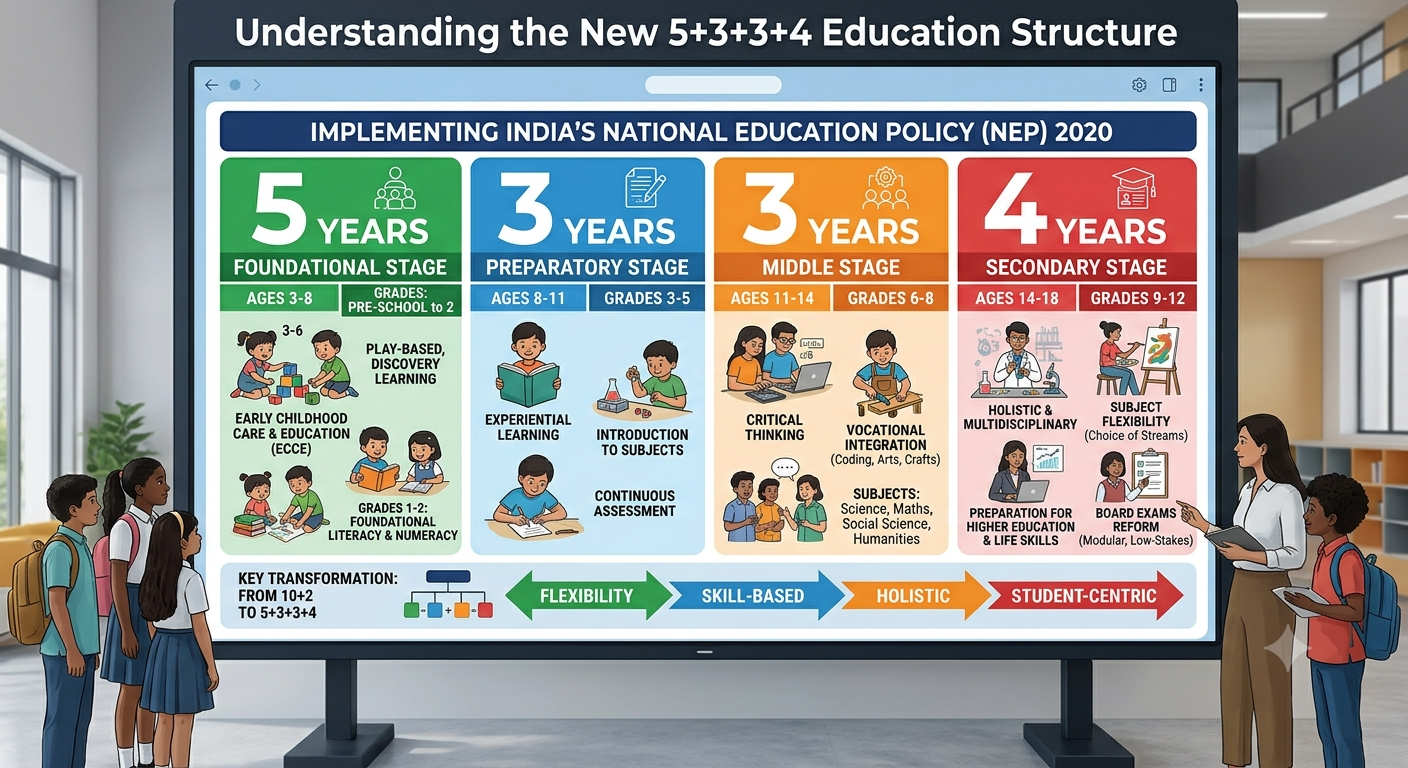
- Foundational Stage – 5 years: Ages 3–8, covering three years of preschool or Anganwadi and Classes 1 and 2.
- Preparatory Stage – 3 years: Ages 8–11, covering Classes 3 to 5.
- Middle Stage – 3 years: Ages 11–14, covering Classes 6 to 8.
- Secondary Stage – 4 years: Ages 14–18, covering Classes 9 to 12.
Features of National Education Policy 2020
The changes suggested under NEP 2020 are not limited to the school timetable or the number of years children spend in each stage. They also cover what students learn, how teachers explain lessons and how children’s progress is assessed. The policy places attention on early childhood education, basic reading and mathematics, practical learning and wider subject choices. These features give parents a better idea of the direction in which school education is expected to move.
1. Early Childhood Care and Education
NEP 2020 gives importance to education for children between the ages of 3 and 6. It recommends providing early learning through preschools, Anganwadis and other early childhood centres, using play, stories, music and activities.
2. Focus on Foundational Literacy and Numeracy
Children need to develop basic reading, writing and mathematics skills during their early school years. The policy gives priority to helping every child achieve these essential skills, particularly by the end of Grade 3.
3. Learning in Mother Tongue or Regional Language
The policy recommends using the home language, mother tongue, local or regional language as the medium of instruction until at least Grade 5, and preferably Grade 8 and beyond, wherever possible. This is intended to help children understand lessons more easily during their early years.
4. More Practical and Experiential Learning
Instead of relying mainly on memorising textbook information, NEP 2020 encourages learning through experiments, projects, discussions and classroom activities. Children get opportunities to understand concepts by applying them in practical situations.
5. Flexible Subject Choices
The policy recommends reducing strict divisions between Arts, Science and Commerce streams. Students should have more opportunities to choose subjects from different areas according to their interests and future plans.
6. Introduction of Vocational Education
NEP 2020 recommends introducing vocational education from Grade 6, including practical activities and internships. Students can get early exposure to different skills, crafts and work-related experiences.
7. Changes in Examination and Assessment Methods
The policy encourages assessments that check how well students understand and apply what they have learned, rather than testing only their ability to memorise answers. It also proposes a more comprehensive way of tracking students’ academic and personal development.
8. Use of Technology in Education
NEP 2020 supports the use of digital tools and educational technology in teaching and learning. Online resources, digital classrooms and other technology-based learning methods can help students and teachers access educational material.
9. Focus on Inclusive Education
The policy aims to improve educational opportunities for children from different social and economic backgrounds, including children with disabilities. It encourages schools to reduce barriers that prevent students from accessing and completing their education.
10. Teacher Training and Professional Development
NEP 2020 recognises the role of teachers in improving classroom learning. It recommends better teacher preparation, regular professional development and opportunities for educators to update their teaching skills.
Major Changes in School Education Under NEP 2020
Parents may notice that some familiar aspects of school education are being approached differently under NEP 2020. The policy proposes a new curricular structure, more flexible subject choices and changes in teaching and assessment methods. Here is a look at some of the major differences between the earlier approach and the direction suggested by NEP 2020.
| Earlier School Education Approach | NEP 2020 Approach |
|---|---|
| Followed the 10+2 curricular structure. | Introduces the 5+3+3+4 curricular structure, covering ages 3 to 18. |
| Greater focus on textbook-based learning. | Encourages activity-based and experiential learning through projects, discussions and practical work. |
| Students often relied on memorising information to prepare for examinations. | Places greater emphasis on understanding concepts and applying knowledge. |
| Arts, Science and Commerce were generally treated as separate streams at the higher secondary level. | Recommends more flexibility to choose subjects from different areas based on students’ interests. |
| Vocational education and practical skill exposure were limited in many schools. | Recommends vocational education and practical exposure from Grade 6 onwards. |
| Assessment largely focused on examination marks and academic performance. | Encourages broader assessment of students’ understanding, skills and overall development. |
Benefits of NEP 2020 for Students
NEP 2020 aims to make school education more flexible and focused on the overall development of children. It encourages students to understand what they learn, explore different subjects and develop skills beyond textbooks. Some of the key benefits expected from this approach include:
1. Better Understanding of Concepts
Activity-based teaching, projects and classroom discussions can help students understand lessons instead of simply memorising information. This approach encourages children to think and apply their knowledge.
2. More Opportunities to Explore Interests
Students are expected to get greater flexibility in choosing subjects, including arts, science, sports and vocational skills. This can help them explore their interests and make better decisions about future studies.
3. Strong Foundation in Reading and Mathematics
NEP 2020 gives priority to basic reading, writing and mathematics skills during the early years of schooling. A strong foundation can help children follow lessons and learn new subjects with greater confidence.
4. Learning in a Familiar Language
Wherever possible, teaching in the home or regional language during the early school years can make lessons easier for children to understand. It may also help them participate more actively in classroom activities.
5. Early Exposure to Practical Skills
Vocational education, hands-on activities and internships are encouraged from the middle school years. These experiences can introduce students to different skills and help them understand how classroom learning connects with everyday work.
6. Less Pressure on Memorisation
The policy recommends assessment methods that give more importance to understanding, problem-solving and applying knowledge. This can encourage students to focus on learning rather than preparing only for marks.
7. Development Beyond Academics
Sports, arts, creativity, communication and other activities are given importance alongside regular subjects. This approach aims to support children’s physical, social, emotional and intellectual development.
8. More Inclusive Learning Opportunities
NEP 2020 aims to improve access to quality education for children from different backgrounds, including those who need additional learning support. The goal is to give every child a better opportunity to continue their education.
What Should Parents Know About NEP 2020?
NEP 2020 brings several proposed changes to school education, and parents may have questions about how these changes will affect their children. While the policy sets the direction for schools, the way it is introduced can differ between states, education boards and individual schools. Parents can keep the following points in mind:
1. Check How the School Is Following the New Curriculum
Parents can ask the school how it is adapting to the 5+3+3+4 structure and what changes have been made to classroom teaching, learning materials and activities. The approach may vary depending on the school and board.
2. Understand the Importance of Early Learning
The foundational stage covers children from ages 3 to 8. Parents should look for age-appropriate activities, stories, play-based learning and support for basic reading and mathematics during these years.
3. Ask About the Medium of Instruction
NEP 2020 recommends teaching in the home, mother tongue, local or regional language wherever possible, at least until Grade 5 and preferably beyond. Parents can check which language the school uses for teaching and how it supports children who are learning in another language.
4. Look Beyond Marks and Examination Results
Parents should also understand how the school tracks a child’s progress in communication, problem-solving, creativity and participation. Regular feedback from teachers can give a broader picture of a child’s learning.
5. Explore Subject Choices and Skill-Based Learning
As students move into higher classes, they may get more opportunities to explore subjects across different areas. Parents can discuss subject options, vocational activities and practical learning opportunities with the school.
6. Stay in Touch With Teachers
Regular communication with teachers can help parents understand their child’s progress and identify areas where additional support may be needed. Parents can also ask how classroom activities and assessments are changing under the school’s curriculum.
7. Do Not Assume Every Change Is Already in Place
NEP 2020 is a policy framework, and its recommendations are being implemented through different education authorities. Not every school will introduce all changes at the same time. Parents should check with their child’s school or education board for the latest information.
Being aware of these changes can help parents understand the new approach to education and support their children’s learning both at school and at home.
Is NEP 2020 Implemented in All Schools in India?
No. NEP 2020 has not been implemented in the same way across all schools in India. The policy is being introduced in phases, with the Central and State governments, education boards and schools sharing responsibility for its implementation. Several initiatives have been introduced, but the pace and extent of implementation vary.
Some of the steps taken to introduce NEP 2020 in school education include:
- New Curriculum Framework: The National Curriculum Framework has been developed to guide changes in teaching and learning at different school stages.
- NIPUN Bharat: This initiative focuses on helping children develop basic reading and mathematics skills by the end of Grade 3.
- PM SHRI Schools: Selected schools are being developed to demonstrate NEP 2020’s approach to teaching, learning and school facilities.
- Play-Based Early Learning: Resources such as Jadui Pitara support activity-based learning for young children.
- Teacher Training: Training programmes are being conducted to help teachers adopt new teaching methods and classroom practices.
Parents should remember that the changes may not be visible in every school at the same time. The curriculum, examination pattern, subject options and teaching methods may differ depending on the school, state and education board. If parents want to know which NEP 2020 changes apply to their children, they can contact the school and check the latest guidelines issued by their respective board.
Changes in School Examinations and Assessment
NEP 2020 recommends changing the way students are tested in schools. Instead of focusing mainly on marks and memorised answers, assessments should check how well children understand concepts, solve problems and use what they have learned.
- Regular Assessments: Teachers are encouraged to assess students throughout the academic year instead of depending only on final examinations.
- Competency-Based Questions: Tests should give more importance to understanding, critical thinking and applying knowledge to real-life situations.
- Examinations in Classes 3, 5 and 8: The policy proposes school examinations at these stages to check students’ learning progress.
- Changes to Board Exams: Class 10 and 12 board examinations will continue, but the policy recommends making them less focused on memorisation and more focused on assessing core competencies.
- Holistic Progress Card: Student progress should cover more than academic marks, including skills, participation and other areas of development.
Frequently Asked Questions About NEP 2020
1. What is the main aim of the National Education Policy 2020?
The main aim of NEP 2020 is to improve the quality and accessibility of education in India. It focuses on early childhood learning, practical skills, flexible subject choices and the overall development of students.
2. When was NEP 2020 introduced in India?
The Union Cabinet approved the National Education Policy on 29 July 2020. It replaced the previous National Policy on Education, which was introduced in 1986.
3. What is the 5+3+3+4 education system?
The 5+3+3+4 structure divides school education into four stages: Foundational (5 years), Preparatory (3 years), Middle (3 years) and Secondary (4 years). It covers children from ages 3 to 18.
4. Does NEP 2020 replace the CBSE and state board systems?
No. NEP 2020 does not replace CBSE or state education boards. It provides a policy framework for changes in school education, which different boards and states work towards implementing.
5. Does NEP 2020 make mother tongue compulsory in schools?
No. The policy recommends using the home language, mother tongue, local or regional language as the medium of instruction until at least Grade 5, and preferably Grade 8 and beyond, wherever possible. It is not a compulsory rule for every school.
6. Will Class 10 and Class 12 board examinations continue under NEP 2020?
Yes. NEP 2020 retains board examinations for Classes 10 and 12 but recommends changes to make them focus more on understanding and applying concepts rather than memorisation.
7. From which class does vocational education start under NEP 2020?
The policy recommends introducing vocational education from Grade 6. Students can get exposure to practical skills, different crafts and internships as part of their learning.
8. Is NEP 2020 applicable to private schools?
NEP 2020 provides a framework for school education across India, including government and private schools. Its recommendations are implemented through the relevant education authorities and boards.
9. Has NEP 2020 been fully implemented in India?
No. Implementation is an ongoing process. Different states, education boards and schools are introducing the policy’s recommendations at different stages.
10. How can parents understand the changes under NEP 2020?
Parents can speak with their child’s school, attend parent-teacher meetings and follow updates from their education board. This helps them understand changes in the curriculum, examinations, subject choices and teaching methods.