
A school’s CBSE affiliation tells you which board it follows, but it doesn’t tell you everything about the school. Two CBSE schools can differ quite a bit in their teaching, class sizes, facilities, fees, activities and approach towards students. Parents therefore need to look beyond the board name when making a choice.
Before making the comparison, here is what parents should know about CBSE.
What is a CBSE School in India?
The Central Board of Secondary Education (CBSE) is a school education board under which affiliated schools operate according to prescribed academic and examination requirements. Its framework covers the curriculum and assessment structure followed by schools at different stages of education.
Beyond those requirements, schools have their own teaching teams, facilities, fee structures, activities and administrative practices. This is why checking the CBSE affiliation is only the first step in evaluating a school.
| What CBSE Covers | What Parents Still Need to Check |
|---|---|
| Curriculum and syllabus | Teaching quality |
| Board examinations | Class size & Parents’s Reviews |
| Affiliation requirements | School fees |
| Academic requirements | Facilities & Activities |
| Certain school standards | Safety and student support |
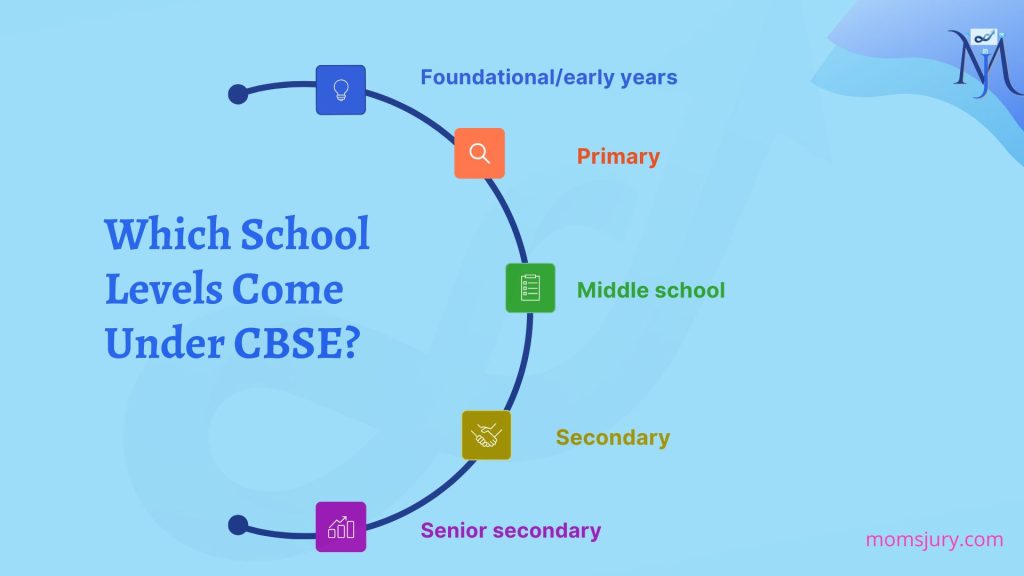
Which Classes Follow the CBSE Curriculum?
From the foundational years to Class XII, CBSE covers different stages of a child’s school education. Here are the different stages a student goes through under the CBSE curriculum:
How to Verify a School’s CBSE Affiliation
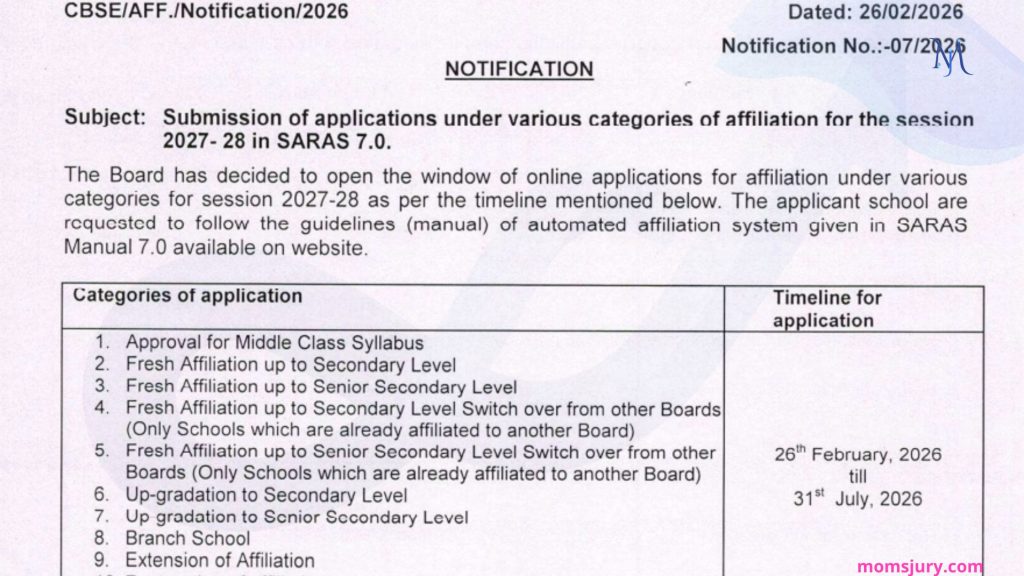
It is worth checking the level of affiliation. CBSE has different affiliation categories, including fresh affiliation, extension of affiliation and upgradation to a higher level. A school affiliated up to the Secondary level, for instance, is different from one that has Senior Secondary affiliation.
CBSE notification showing the categories of affiliation applications for the 2027–28 academic session.
Source: CBSE
There is a difference between a school affiliated up to Secondary and one affiliated up to Senior Secondary. So a school affiliated up to Secondary should not be treated as having Senior Secondary approval. The CBSE record is the better place to confirm this, even if the school has already provided affiliation details on its website.
How to Check a School’s CBSE Affiliation Online
- Search for the school in the official CBSE SARAS directory.
- Check the school’s name and affiliation number.
- Look at the affiliation status.
- Check the level up to which the school is affiliated.
- Compare the CBSE record with the information given by the school.
How Does the CBSE Curriculum Work?
A child does not follow one fixed set of subjects throughout CBSE schooling. Number of subjects, subject choices and assessment requirements are not fixed throughout the entire school journey.
- Curriculum structure: The curriculum is set for different stages of school education.
- Subjects: Younger students have a set range of subjects. The choices become wider in senior secondary.
- Assessment: Assessment includes school-level tests and examinations, along with practical work where required.
- Board examinations: Class X and XII students take the CBSE board examinations.
- Academic progression: Students gradually move from one level of study to the next as they go through the classes.
A Simple CBSE School Selection Checklist
Before Shortlisting
- ☐ CBSE affiliation verified
- ☐ Location checked
- ☐ Fees understood
- ☐ Academic approach reviewed
- ☐ Facilities checked
- ☐ Safety arrangements reviewed
- ☐ Transport checked
- ☐ Reviews researched
Before Visiting
- ☐ Questions prepared
- ☐ Fee questions prepared
- ☐ Admission requirements noted
During the Visit
- ☐ Classrooms observed
- ☐ Teachers observed/interacted with
- ☐ Toilets checked
- ☐ Playground checked
- ☐ Security observed
- ☐ Transport arrangements understood
Before Final Decision
- ☐ Child’s opinion considered
- ☐ Two or more schools compared
- ☐ Total annual cost calculated
- ☐ Admission terms understood
- ☐ Final school shortlisted
Why Do Parents Choose CBSE Schools?
For some parents, the biggest advantage of CBSE is simply its reach. The board is available in many parts of India, which matters to families who may not stay in the same city for their child’s entire schooling. Its national curriculum and familiar academic pattern are other reasons it continues to be considered when families compare school boards.
What makes CBSE worth considering:
- Nationally structured curriculum: CBSE provides an academic framework followed by its affiliated schools, rather than having a separate curriculum for each school.
- Popular academic system: CBSE is already known to a large number of Indian parents, students and educators.
- Plenty of schools to choose from: Parents can compare CBSE schools on practical matters such as fees, distance, facilities, class size and activities.
- Subject options after Class X: Students entering senior secondary classes can choose from the subjects and combinations available at their school.
- Useful for families who may relocate: A move from one city to another does not always mean moving to a different board. You can search for another CBSE school at the new location.
- Relevant when planning for competitive exams: Some families also look at CBSE while considering future national-level entrance examinations, particularly when planning around subjects that may be part of those exams.
- Different types of schools: CBSE affiliation does not mean every school is similar to each other. Fees, facilities, teaching practices, activities and school culture can differ considerably.
What questions should I ask a CBSE school?
- Is the school’s CBSE affiliation current?
- What is the average class size?
- How are students assessed apart from exams?
- How does the school help students who need extra academic support?
- Which subjects and combinations are available in Classes XI and XII?
- What are the total yearly fees, including other regular charges?
- Are there any additional charges for books, uniforms, activities or transport?
- What are the school timings?
- How does the school handle student safety and security?
- What transport options are available?
- How are parents informed about their child’s academic progress?
- What is the process for admission and withdrawal?
- Can parents speak with teachers when there is a concern about the child?
Common Mistakes Parents Make When Choosing a CBSE School
These are some common mistakes to watch for while comparing CBSE schools:
- Choosing a school only because it has a good reputation
- Assuming every CBSE school offers the same quality of education
- Checking only the tuition fee and ignoring other yearly expenses
- Not verifying the school’s CBSE affiliation
- Giving too much importance to facilities and buildings
- Not checking the daily travel time from home
- Skipping the school visit before admission
- Relying only on online reviews
- Not asking about class size and teacher availability
- Choosing a school without considering the child’s interests and needs
FAQs
What Does CBSE Stand For?
CBSE stands for Central Board of Secondary Education. It is a national-level school education board in India.
Does CBSE affiliation mean every school is the same?
No. CBSE sets the academic framework, but the way a school operates can be very different from another CBSE school. Teaching practices, fees, facilities, class strength and the activities offered can vary from school to school. The school environment and culture can also be quite different.
Is CBSE automatically the best board?
No, It can be a good fit for some children and families, while another board may suit others better. The choice should be based on the child and the family’s requirements.
Is CBSE the Right Choice for All Children?
CBSE may suit many children, but there is no need to assume it will suit everyone. The child’s way of learning, interests and plans for higher education can all matter when choosing a board.
What Are the Downsides of CBSE Syllabus?
The board is only one part of the decision. A parent may find that the CBSE school they like has higher fees, a large class strength or fewer subject choices than expected. These are things to check with the school rather than assuming that CBSE affiliation covers them.
Should I choose CBSE school based on its board exam results?
Good results can be a positive point, but they don’t give the full picture. Before taking admission, find out what the school is like for students who are not among the top scorers too. Ask about regular teaching, support for students and the overall academic pressure.